Electronics
The WII6 board: an STM32U575 on Zephyr, an ESP32-S3 debug processor, Iridium Certus, and power and voltage monitoring on multiple buses.
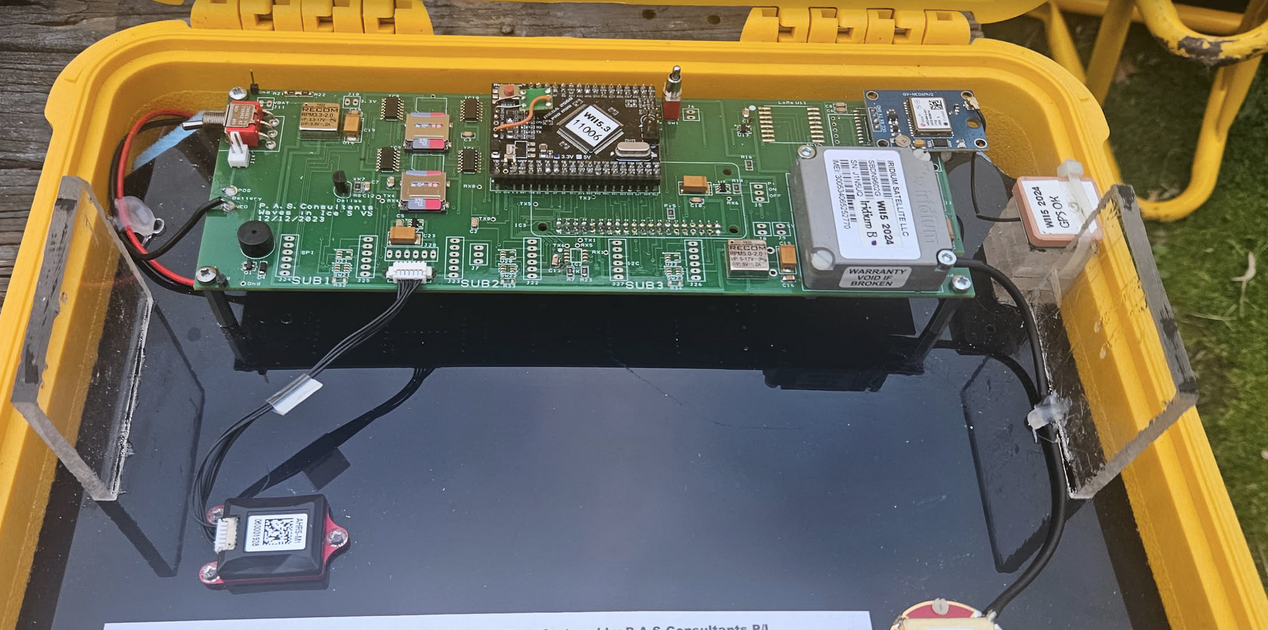
A WII5 hull of the kind the WII6 electronics are designed to fit.
A WII6 buoy sits on sea ice or floats at the ice edge and measures how the surface moves. It records motion, computes the wave statistics on board, and sends the selected data over Iridium. The full record is written to the card.
Capture length, sampling rate and reporting interval are configurable. A fifteen-minute capture every two hours is one example. Reporting can be every fifteen minutes, once a day or on another interval, and captures can be shorter or longer to suit the deployment.
| Sensor | Measurements and purpose |
|---|---|
| Motion sensor | acceleration and orientation for the wave maths; the Sparton AHRS-M2 is an option proven on multiple WII5 deployments |
| GNSS | position and time from a single receiver |
| Heading | motion-sensor heading, with a dual-antenna GNSS model available for accurate direction near the poles |
| Temperature probes | air and water temperature, according to the deployment’s probe arrangement |
| Power monitoring | power and voltage measured on multiple buses to track the buoy’s health |
Messages can start with 326 bytes of wave results: significant wave height, peak period, the power spectrum, direction and quality flags. Position and buoy health can be sent alongside them.
You choose which captures send just the power spectrum, which send a 2 Hz record, and which send the full-rate record at 8 or 64 Hz. For a fifteen-minute capture, the 2 Hz record is about 56 kB and fits in a single Iridium Certus message. It lets you rerun the later processing stages on shore with different settings.
Full-rate transfers use more airtime and cost more, so the 2 Hz record is the practical choice for most satellite reprocessing requests. The full record remains on the card for recovery. It includes the filtering already applied inside the motion sensor.
| Feature | WII5 v2 | WII6 |
|---|---|---|
| Main processor | ATmega2560 at 11 MHz, 8 kB RAM | STM32U575, Cortex-M33 at 160 MHz, 786 kB SRAM |
| Wave maths | on a Raspberry Pi woken for the job | on the main processor, using SRAM |
| Satellite | Iridium SBD, 340 bytes a message | Iridium Certus, about 100 kB a message |
| Firmware | Arduino | Zephyr RTOS |
| Debug and local access | Raspberry Pi | ESP32-S3 with WiFi, off in deployment |
| Storage | two SD cards | one SD card, a write-once record layout |
| Power | per-peripheral switches | switched supplies, with power and voltage measured on multiple buses |
The Sparton motion sensor remains an option for WII6, building on its use in multiple WII5 deployments. Earlier generations used a Kistler single-axis accelerometer with a lower-cost inertial measurement unit (IMU). The heritage page traces that development.
The WII6 electronics are in bench bring-up on development boards: the sensors, the card, the satellite modem and the link to the dashboard all exercised one at a time by a hardware test suite before a board is laid out. If you are planning a season, get in touch for the current development schedule.
The WII6 board: an STM32U575 on Zephyr, an ESP32-S3 debug processor, Iridium Certus, and power and voltage monitoring on multiple buses.
What a WII buoy enclosure has to survive on Antarctic sea ice, and the forms it takes: the ice-surface box, the floating hull, the tethered variant.