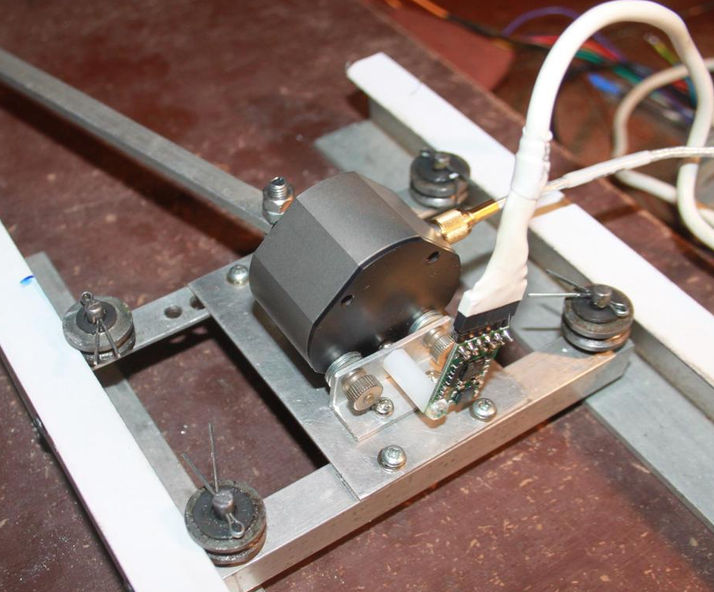
The test rig subjects the sensor to a known motion to check the processing from sensor readings through to wave results.
What it computes
Each capture records motion from the chosen sensor, with the sampling rate and capture length set for the deployment. On the buoy that becomes:
| Group | Results |
|---|---|
| Heights and periods | significant wave height, peak period, the largest zero-crossing heights, crests and troughs per segment |
| Spectrum | the 55-bin power spectral density and the seven spectral moments |
| Direction | mean direction, direction at the peak, spread, unimodality ratio, and the directional spectrum over the wave band |
| Quality | flags showing sensor and processing status alongside the results |
Wave results can be sent in compact packets from 326 bytes. You choose which captures send just the power spectrum, a 2 Hz record or the full-rate data at 8 or 64 Hz.
Scientific background
The wave-motion mathematics was developed by Dr Alison Kohout of NIWA and collaborators, and it is the scientific core of every WII generation. The 2014 Nature paper on storm-induced sea-ice breakup, and the papers since, rest on it. Her project pages and the publication list are linked from the heritage page.
Why on the main processor
Every WII generation has run the wave maths on the buoy itself. What changed is where it runs. Earlier generations gave the job to a second computer on the buoy, a large single-board computer such as a BeagleBone or a Raspberry Pi. It worked, but the extra board was costly, fragile and a large part of the power budget.
WII6 runs the processing on its main processor, using its working memory. The processing sits on the same small embedded CPU that reads the sensors and runs the rest of the firmware:
- Compact wave results can be sent on the schedule you choose.
- There is no second computer to power, keep warm or fail.
- The 2 Hz record from a fifteen-minute capture fits in one Certus message, so later processing stages can be rerun on shore with different settings.
Full-rate transfers use more airtime, so the 2 Hz record is usually the practical choice for reprocessing over satellite. All records include the filtering already applied inside the motion sensor.
Testing the maths
Changes to the wave maths are tested against reference results and recorded captures to check quality and consistency. The test records and processing versions are retained so the comparisons can be repeated.
Ask us for the comparison tools and sample records if you want to run the checks yourself or compare them with your own analysis.
Options for your deployment
- The wave band and frequency bins were set for Antarctic sea ice. Other sites may want them moved.
- The standard setup uses a single GNSS receiver for position and time, with heading from the motion sensor. A dual-antenna GNSS model is available for accurate direction near the poles.
- The channels included in a 2 Hz record can be discussed to suit your analysis.